GuideLast updated September 14, 2026
Does a Shopify age verification popup stop checkout?
A popup alone does not provide server-side enforcement. A popup decides what a visitor is shown. Refusing to complete an order is a different mechanism running somewhere else.
Two different jobs that share a name
“Age verification” on the Shopify App Store covers two things that behave differently:
- A display gate. JavaScript in your theme renders a modal and decides what the visitor sees. This is the popup a shopper sees.
- An order-level check. Something evaluated on Shopify’s side when the cart is submitted, which can refuse to let the order complete.
The first runs in the shopper’s browser, which is a place you do not control. Disable JavaScript, use a direct cart permalink, or complete a purchase through a channel that never loaded your theme, and the modal was never part of the transaction.
Why the browser cannot be the last word
Anything running in the shopper’s browser is advisory. That is not a flaw in any particular app, it is what client-side code is. A storefront gate is a good deterrent against a casual visitor and no obstacle to a deliberate one.
If you are gating because a licence depends on it, the question to ask a vendor is narrow: when the order is submitted, does anything on the server refuse it? Some apps answer yes, some answer no, and both describe the product as age verification.
What enforces on Shopify
Shopify exposes cart and checkout validation functions, which run on Shopify’s infrastructure when a cart is submitted and can block it. An app can use one to require a marker showing the age check was completed, and refuse carts that lack it.
Shopify documents the mechanism in its cart and checkout validation reference.
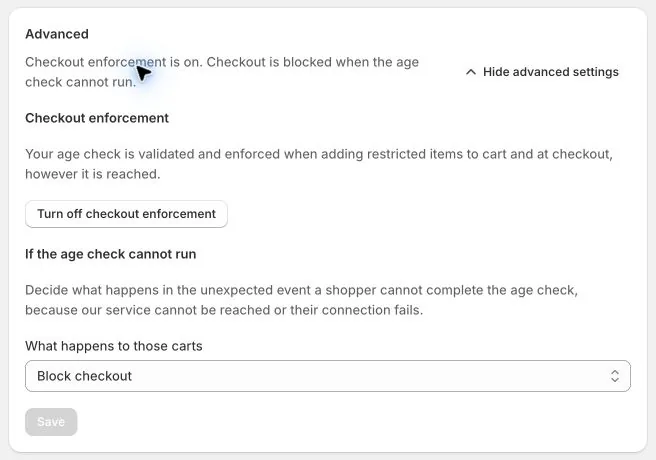
For Hatchway, two outage behaviors matter:
- It keeps working if the app’s servers go down, because the function runs inside Shopify with no network call out. That is a genuine reliability property.
- It cannot tell an outage from a refusal. The function sees a marker or it does not. If a first-time shopper cannot reach the app to complete the check, they cannot get the marker, and they are blocked. Ask what an app does in that case, because the honest answers are “block the sale” or “let it through and flag it”, and you should know which one you bought.
Which sales channels it reaches
Hatchway’s theme-based gate renders on your Online Store. The enforcement claim covers Online Store orders, not marketplace purchases.
If you sell through other channels, check their requirements and supported controls separately. Do not assume Hatchway covers those purchases.
No self-declaration gate makes a sale lawful. When enabled, Hatchway checks for a valid confirmation on restricted Online Store purchases. It does not establish whether the declaration was true.
Someone who clicks past the gate untruthfully produces a valid confirmation, and the check honors it. That is what self-declaration means, at every price point, and no app should tell you otherwise.
What to ask before you buy
- Is the block enforced server-side when the order is submitted, or only rendered in the storefront?
- Which sales channels does enforcement cover, and which does it not?
- What happens to a first-time shopper if your service is unreachable?
- Can I gate individual products, or is it my whole storefront?
- Is there a record I can produce months later showing what the gate did?
That last one gets overlooked. A gate that correctly blocked nothing last month looks exactly like a gate that was silently switched off, unless something kept a record.
Common questions
Does a Shopify age verification popup stop someone from checking out?
A popup alone does not provide server-side enforcement. A popup is storefront JavaScript that decides what a visitor is shown. Checkout is a separate surface, so refusing the order needs a server-side check such as a Shopify checkout validation function.
What is the difference between an age gate and age verification?
An age gate asks a shopper to declare their age and records the answer. Identity verification checks a document or biometric against a real identity. Hatchway uses self-declaration, so a shopper who answers untruthfully can pass.
Does checkout age verification work on every Shopify sales channel?
Hatchway’s enforcement claim covers the Shopify Online Store. Do not assume coverage on marketplaces or other sales channels.
Where Hatchway fits
Hatchway Age Gate does both halves, and separates them by plan. The storefront gate and per-product targeting are free. Server-side checkout enforcement is on the Pro plan, it covers Online Store orders, and it is off until you turn it on.
Pro also provides reference lookup and CSV records. Optional order references are off until enabled separately. The ledger does not automatically reconcile completed orders. Growth and Pro include analytics.